Contents
Early childhood music education is not about turning a young child into an instrument expert. At this stage the goal is to give the child the right environment to listen to music, feel it and make it themselves. In this guide I explain what you can do at each age from 0 to 6, when a child can start piano, and a simple routine you can use at home.
We have been developing our colour- and shape-based piano method with young children for more than 12 years, first with our own students in the United States, then in Istanbul. The suggestions below draw on that experience and on the relevant research.
1. Why the early years matter
A child's brain develops very quickly in the first years and is highly sensitive to sounds, rhythms and language in the environment. Music fits this period naturally, because children respond to rhythm and melody on their own.
- A short rhythm-play programme with nine-month-old babies strengthened how they processed timing patterns in both music and speech (Zhao & Kuhl, 2016).
- Babies who took part in active music classes with their parents showed earlier communicative gestures and more positive social behaviour than babies who only listened to music (Gerry, Unrau & Trainor, 2012).
- Children who often sang with their parents at home at age 2–3 had slightly better vocabulary, number skills and attention at age 4–5 (Williams et al., 2015).
The common thread: the difference appears when the child actively takes part in music, and does so together with an adult. If you are curious about music and intelligence, you will find a detailed summary of the research in our article Do music lessons make children smarter?
2. Music by age: 0–6 years
Listening and sound play
Lullabies, nursery rhymes and short songs. Rocking your baby to a beat, putting their name into a song, making your voice softer and louder. Your baby loves your voice more than any recording.
Rhythm and movement
Clapping, keeping a beat while walking, stop-and-go games, simple percussion (shakers, tambourine, wooden spoons). Action songs are the favourite activity at this age.
First keys
Recognising and repeating short songs. Simple one-hand melodies on the keyboard with visual cues (colours, shapes). Attention spans are short, so 10–15 minute sessions are ideal.
Two hands and regular practice
Using the right and left hand separately, then together. Playing a song from start to finish, playing with someone else. This is when the groundwork for reading notation is laid.
3. What age can a child start piano?
Traditional piano lessons based on reading notation usually start around ages 5–7. That is because reading music is an abstract skill: the child has to distinguish lines, spaces and symbols, and turn them into finger movements.
But there is no need to wait until then to meet the piano. Starting from age 2.5 with concrete visual cues such as colours and shapes is possible. Children usually show they are ready through signs like these:
- They can stay with one activity for a few minutes.
- They can tell colours apart and match them.
- They can press a single key on purpose with one finger.
- They hum a song they know or move along to its rhythm.
If most of these are true, you can start with short, playful sessions. I explain which keyboard suits which age and budget in our keyboard buying guide.
4. A 10-minute music routine at home
You don't need any special training. It only needs to be regular and enjoyable. A sample routine:
- Warm-up (2 min): Sing a song you both know and clap the beat.
- Listen and repeat (2 min): Clap or play a short rhythm and let your child repeat it. Then swap roles.
- Keyboard (4 min): Play a short melody of one or two bars together. Mistakes are fine; hearing what they played is what matters.
- Free play (2 min): Let your child make up their own "song". Be the audience and applaud.
Ten minutes every day rather than one hour a week: with young children, consistency matters more than duration.
5. What to look for in an early years music class
- Is the child active? Does the child sing, move and play during the class, or mostly listen?
- Is the length right for the age? For ages 3–5, classes of 30–40 minutes with a variety of activities are ideal.
- Are parents involved? Especially under age 3, a parent taking part makes it easier to bring what was learned home.
- How is success defined? In the first months the goal should not be performance, but the child enjoying music, focusing, and being able to play their first songs.
- Group or individual? At a young age, group classes are valuable for sharing and moving together. Studies show that four-year-olds who made music together helped each other more (Kirschner & Tomasello, 2010).
6. Starting with colours and shapes
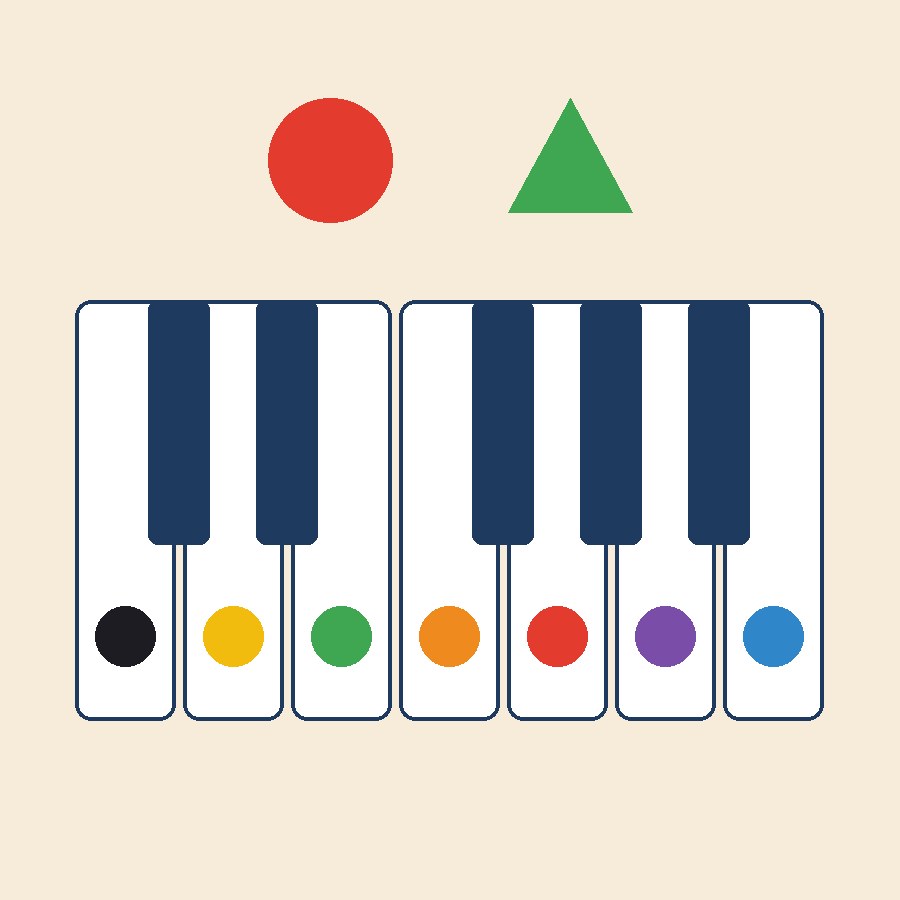
In our method every key has a colour. Seven colours correspond to the seven white keys of the keyboard. A circle shows the right hand, a triangle the left. So in the very first lesson a young child can see the colour, find the key, press it with the correct hand and hear a song they recognise.
This approach does not remove notation. Once the child is confident with colours and shapes, they move to notation step by step, using the same songs. The method's app is used in 48 countries today. We also use the same method with adults starting piano later in life.
Play a first song together
We made a demo song you can try right away in your browser. The app is free on iPhone, iPad and Android.
Open the demo songFrequently asked questions
At what age does early childhood music education start?
Meeting music can start from birth: songs, lullabies and rhythm games. A structured start on an instrument is possible from around 2.5–3 years with visual cues such as colours and shapes.
Can a 3-year-old learn piano?
Yes, with the right approach. At this age short (10–15 minute), playful sessions and concrete visual cues work well. The goal is for the child to play simple one-hand melodies and enjoy music.
What are the benefits of early music education?
Research shows positive links especially in auditory discrimination, rhythm, readiness for language skills, attention and moving together with others. The effect on general IQ is debated and small.
What if we don't have a piano at home?
A 61-key keyboard with light keys is enough to start. Before buying a keyboard, you can build a strong musical foundation with songs, rhythm and movement games.
What should I do if my child gets bored?
Shorten the session, go back to a song your child loves, and let them play freely for a while. With young children, short and enjoyable repetition lasts longer than pushing.
References
- Gerry, D., Unrau, A., & Trainor, L. J. (2012). Active music classes in infancy enhance musical, communicative and social development. Developmental Science, 15(3), 398–407. doi:10.1111/j.1467-7687.2012.01142.x
- Kirschner, S., & Tomasello, M. (2010). Joint music making promotes prosocial behavior in 4-year-old children. Evolution and Human Behavior, 31(5), 354–364. doi:10.1016/j.evolhumbehav.2010.04.004
- Williams, K. E., Barrett, M. S., Welch, G. F., et al. (2015). Associations between early shared music activities in the home and later child outcomes. Early Childhood Research Quarterly, 31, 113–124. doi:10.1016/j.ecresq.2015.01.004
- Zhao, T. C., & Kuhl, P. K. (2016). Musical intervention enhances infants' neural processing of temporal structure in music and speech. PNAS, 113(19), 5212–5217. doi:10.1073/pnas.1603984113
Related articles
Do music lessons make children smarter?
Do music lessons raise a child's IQ? From the Mozart effect to brain imaging studies, a plain-language summary of research on early music education and children's intelligence.
Read the article →
The Right Keyboard for Your Child: A Parent's Guide
Keyboard picks by age and budget, and what to look for: a practical guide for parents.
Read the article →
Dr. Erman Türkili
Creator of the colour- and shape-based piano method. Faculty member at Bahçeşehir University Conservatory.
Member of the European Academy of Sciences and Arts