Contents
The question I hear most often from parents is: "Will music lessons make my child smarter?" The answer is more interesting than most people expect. In this article I summarise, in plain language, what peer-reviewed research says about early music education and children's intellectual development. We will look at what is actually known, not at bold promises.
1. The short answer
- Listening to music does not make a child permanently smarter. The idea that "babies who listen to Mozart become more intelligent" is not supported by research.
- Making music (singing, keeping a beat, playing an instrument) is linked to measurable changes in the brain, especially in areas related to hearing, sound discrimination and fine motor skills.
- The effect on general IQ is debated. Some studies find a small increase; when study quality is taken into account, that effect largely disappears.
- On the other hand, positive effects of early music activities on language skills, attention, moving together and sharing are observed more consistently.
So it is more accurate to think of music education not as an "intelligence pill", but as a rich learning environment that supports a child's development in many ways.
2. Where did the "Mozart effect" come from?
In a short study published in Nature in 1993, university students did slightly better on a spatial reasoning task after listening to Mozart for ten minutes (Rauscher, Shaw & Ky, 1993). The effect lasted about ten to fifteen minutes, and the study was done with adults, not children.
Even so, the finding quickly turned into the message "play Mozart to your baby to raise their IQ". Later meta-analyses clarified the picture: the small effect can be explained by music making people temporarily more alert and in a better mood (Chabris, 1999). A larger analysis combining around forty studies found no effect specific to Mozart; other kinds of music produced similarly small results (Pietschnig, Voracek & Formann, 2010).
Playing music to your baby is a lovely habit. But the real difference appears when the child takes part in the music.
3. Listening to music is not the same as making music
When a child sings, claps or presses a key, they are doing many things at once: listening to the sound, following the rhythm, moving the hand at the right moment, anticipating the next step and hearing the result. This loop engages hearing, movement, attention and memory together.
You can see this even in babies. In a study with six-month-old infants, babies who took part in active music classes with their parents showed earlier and more advanced communicative gestures, and more positive social behaviour, than babies who only listened to music for the same period (Gerry, Unrau & Trainor, 2012). The difference was not whether music was present, but how much the baby took part in it.
4. What does music training change in the brain?
Brain imaging studies show that regular music training is linked to observable changes in the brain:
- Hearing and movement areas. Children of about six who had keyboard lessons for 15 months developed structural differences in brain regions related to hearing and finger movement, compared with peers who did not. These differences were also linked to their progress in musical and motor skills (Hyde et al., 2009).
- Connections between the two hemispheres. Over two years, children in a music programme showed different development in auditory regions and in the pathways connecting the two halves of the brain, compared with children in a sports programme and children with no programme (Habibi et al., 2018).
- Processing speech sounds. In a study with children from disadvantaged neighbourhoods, two years of music training sharpened how the brain distinguishes speech sounds. One year was not enough for this effect (Kraus et al., 2014). Consistency matters.
- Rhythm and speech in infancy. A 12-session rhythm-play programme with nine-month-old babies strengthened how they processed timing patterns in both music and speech (Zhao & Kuhl, 2016).
These findings are important, but they need to be read carefully: brain changes are seen mostly in skills directly related to music, namely hearing, rhythm and hand coordination. Whether this turns into an increase in "general intelligence" is a separate question.
5. So does IQ go up?
One of the most cited studies on this question was carried out in Canada. 144 six-year-olds were randomly assigned to four groups: keyboard lessons, voice lessons, drama lessons, and no lessons. After a year, IQ scores rose slightly more in the music groups than in the others. The researcher stressed that the effect was small (Schellenberg, 2004). Another study with preschoolers found gains in verbal intelligence after only 20 days of a computer-based music programme (Moreno et al., 2011).
On the other hand, a recent meta-analysis combining studies with nearly 7,000 participants found that once study quality (random assignment, active control groups) was taken into account, the effect of music training on general cognitive and academic skills was close to zero (Sala & Gobet, 2020).
My conclusion from this picture: choosing music lessons to raise a child's IQ score is not the right expectation. Music education is valuable because music itself is valuable, and because it brings habits of attention, patience, listening and making things together.
6. Beyond intelligence: language, attention and social skills
While IQ remains debated, early music activities are more consistently linked to other areas of development:
Language and reading readiness
When preschoolers did short music activities every day for 20 weeks, their ability to distinguish sounds and recognise syllables (phonological awareness) improved. This skill is one of the building blocks of learning to read (Degé & Schwarzer, 2011).
Sharing and helping
Four-year-olds who sang and kept a beat together helped each other more afterwards than children who played a non-musical game for the same time (Kirschner & Tomasello, 2010). Making music together requires tuning in to a shared goal.
Music at home
An Australian study following thousands of families found that children whose parents often sang and did music activities with them at age 2–3 had slightly better vocabulary, number skills, attention and emotional regulation at age 4–5 (Williams et al., 2015). The effects were small but meaningful, and these activities require no special equipment.
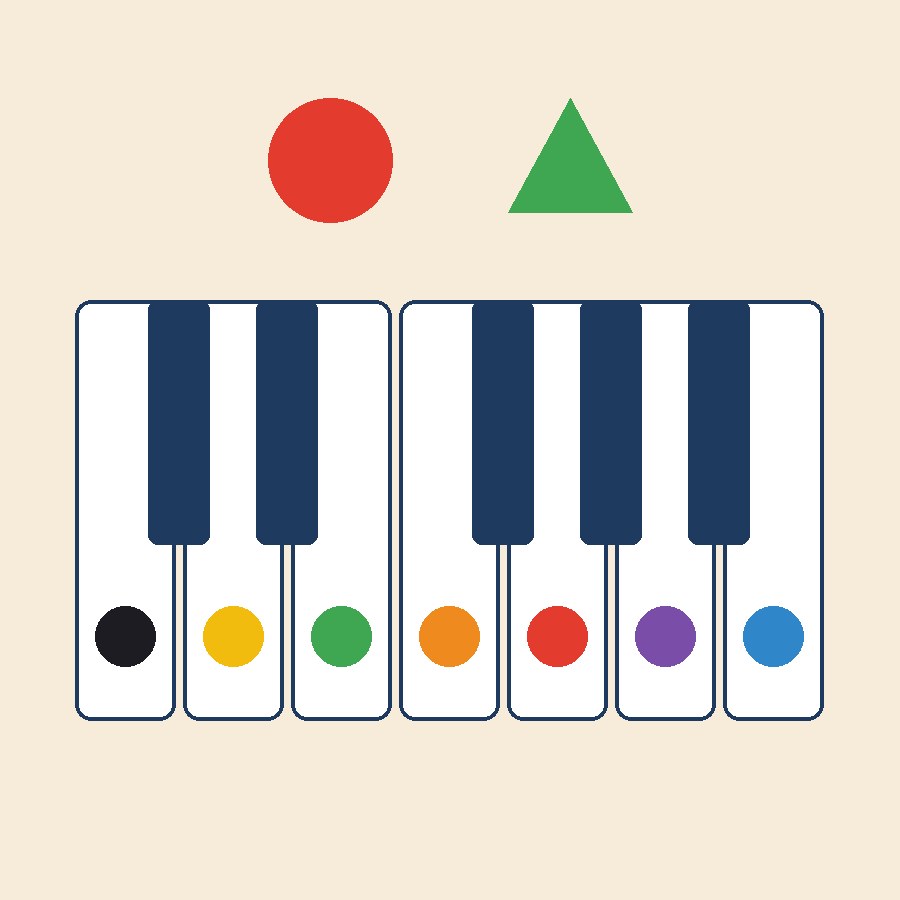
A first song that starts with colours
In the First Steps of a Little Artist app every key has a colour; a circle for the right hand, a triangle for the left. Children follow the colours to play their first song, then move to notation step by step. Suitable from age 2.5 and free.
Try it in your browser7. What this means for parents
- Don't just play music, join in. Singing together, clapping, or keeping a beat on a saucepan is a richer experience than passive listening.
- Keep it short and regular. For young children, 10–15 minutes a day works better than one long lesson a week. Research also points to the importance of consistency.
- Choose an age-appropriate start. For ages 2.5–5, rhythm, movement, songs and visual cues such as colours and shapes are a good beginning. Reading notation can come later, step by step. For details by age, see our guide to early childhood music education.
- Don't measure success by IQ. Your child playing a whole song, remembering a rhythm, or playing together with someone else are real achievements.
- Start with the right instrument. If you are thinking about a keyboard at home, our keyboard buying guide gives recommendations by age and budget.
Frequently asked questions
Does playing classical music to my baby increase their intelligence?
No, there is no reliable evidence for this. The "Mozart effect" was a small effect in adults that lasted a few minutes, and later analyses showed it was not specific to Mozart. Listening to music is a pleasant habit; developmental benefits come mainly from the child actively taking part in music.
At what age should music education start?
Meeting music can start in infancy: songs, rhymes and rhythm games. A structured start on an instrument is possible from around 2.5–3 years with visual cues. Traditional notation-based lessons usually begin around ages 5–7.
Do music lessons improve school performance?
Meta-analyses of high-quality studies show that the effect of music training on general academic achievement is very small or close to zero. However, positive results have been reported for specific skills such as sound awareness, which is linked to reading readiness.
Which instrument is best for brain development?
Research has not found any single instrument to be superior. Keyboard and piano are a practical start for young children, because the sound comes immediately and the keys are visually ordered. The best instrument is the one your child wants to play regularly.
Can my child start piano before reading music?
Yes. At a young age, starting with visual cues such as colours and shapes lets a child play songs from the first day. Notation is introduced gradually, step by step, when the child is ready.
References
- Chabris, C. F. (1999). Prelude or requiem for the 'Mozart effect'? Nature, 400, 826–827. doi:10.1038/23608
- Degé, F., & Schwarzer, G. (2011). The effect of a music program on phonological awareness in preschoolers. Frontiers in Psychology, 2, 124. doi:10.3389/fpsyg.2011.00124
- Gerry, D., Unrau, A., & Trainor, L. J. (2012). Active music classes in infancy enhance musical, communicative and social development. Developmental Science, 15(3), 398–407. doi:10.1111/j.1467-7687.2012.01142.x
- Habibi, A., Damasio, A., Ilari, B., et al. (2018). Childhood music training induces change in micro and macroscopic brain structure. Cerebral Cortex, 28(12), 4336–4347. doi:10.1093/cercor/bhx286
- Hyde, K. L., Lerch, J., Norton, A., et al. (2009). Musical training shapes structural brain development. Journal of Neuroscience, 29(10), 3019–3025. doi:10.1523/JNEUROSCI.5118-08.2009
- Kirschner, S., & Tomasello, M. (2010). Joint music making promotes prosocial behavior in 4-year-old children. Evolution and Human Behavior, 31(5), 354–364. doi:10.1016/j.evolhumbehav.2010.04.004
- Kraus, N., Slater, J., Thompson, E. C., et al. (2014). Music enrichment programs improve the neural encoding of speech in at-risk children. Journal of Neuroscience, 34(36), 11913–11918. doi:10.1523/JNEUROSCI.1881-14.2014
- Moreno, S., Bialystok, E., Barac, R., et al. (2011). Short-term music training enhances verbal intelligence and executive function. Psychological Science, 22(11), 1425–1433. doi:10.1177/0956797611416999
- Pietschnig, J., Voracek, M., & Formann, A. K. (2010). Mozart effect–Shmozart effect: A meta-analysis. Intelligence, 38(3), 314–323. doi:10.1016/j.intell.2010.03.001
- Rauscher, F. H., Shaw, G. L., & Ky, K. N. (1993). Music and spatial task performance. Nature, 365, 611. doi:10.1038/365611a0
- Sala, G., & Gobet, F. (2020). Cognitive and academic benefits of music training with children: A multilevel meta-analysis. Memory & Cognition, 48(8), 1429–1441. doi:10.3758/s13421-020-01060-2
- Schellenberg, E. G. (2004). Music lessons enhance IQ. Psychological Science, 15(8), 511–514. doi:10.1111/j.0956-7976.2004.00711.x
- Williams, K. E., Barrett, M. S., Welch, G. F., et al. (2015). Associations between early shared music activities in the home and later child outcomes. Early Childhood Research Quarterly, 31, 113–124. doi:10.1016/j.ecresq.2015.01.004
- Zhao, T. C., & Kuhl, P. K. (2016). Musical intervention enhances infants' neural processing of temporal structure in music and speech. PNAS, 113(19), 5212–5217. doi:10.1073/pnas.1603984113
Related articles
Early childhood music education: a parent's guide for ages 0‑6
When and how should early childhood music education start? Age-by-age music activities for 0-6 years, the right age to start piano, and a 10-minute routine for home.
Read the article →
The Right Keyboard for Your Child: A Parent's Guide
Keyboard picks by age and budget, and what to look for: a practical guide for parents.
Read the article →
Dr. Erman Türkili
Creator of the colour- and shape-based piano method. Faculty member at Bahçeşehir University Conservatory.
Member of the European Academy of Sciences and Arts